
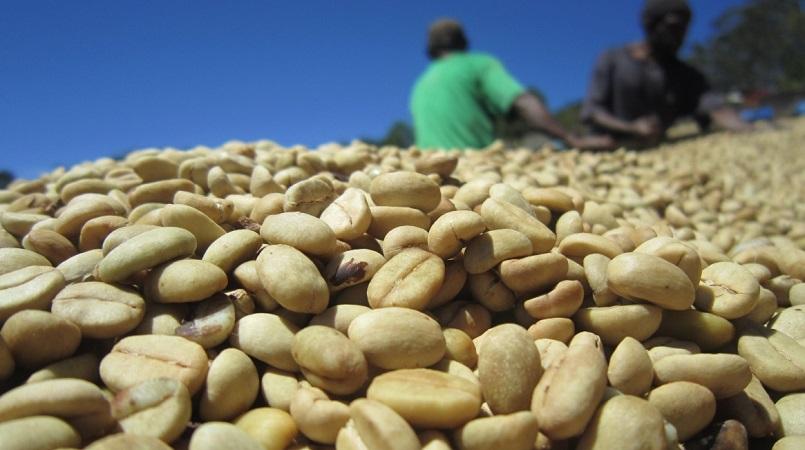
In the coffee industry, there are many ways to classify beans such as: size, cultivation height, number of defects, species, etc. In order to achieve uniformity of coffee beans before roasting, as well as to guide the price in the market, people will classify coffee bean size.
Classification by coffee bean size is a common measure for the coffee industry. In which, coffee beans after preliminary processing will be screened through perforated metal plates with different diameters from 8 to 20/64 inches for classification.
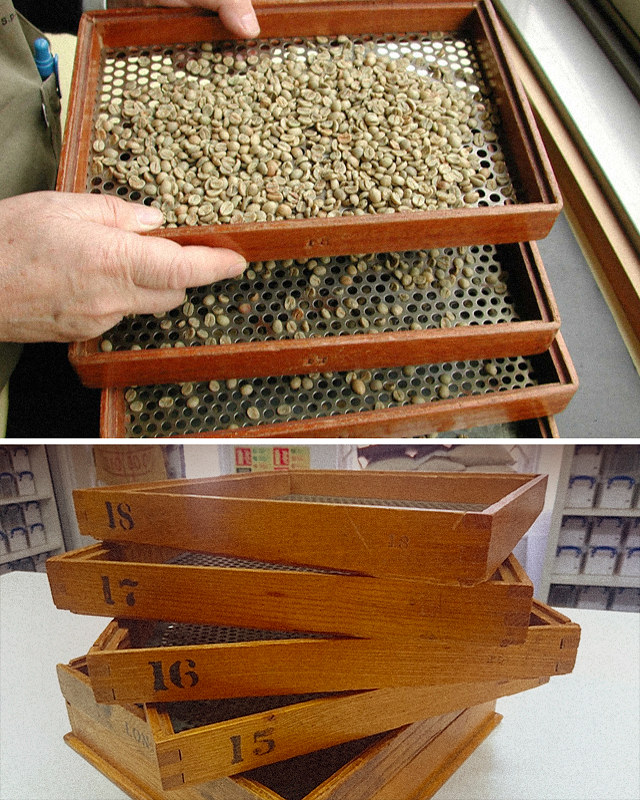
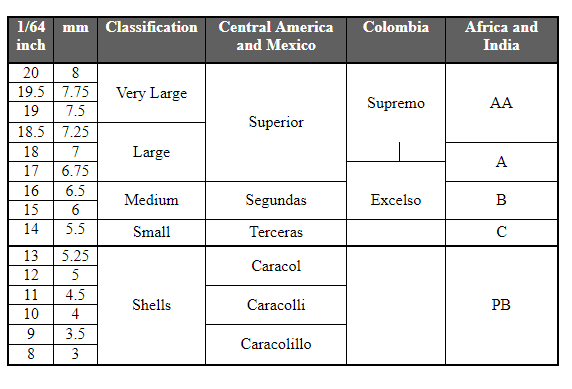
Sieve size from 8 to 20, screen size according to the ratio of 1/64 inch. Screen 18 means 18/64 inch, converted to mm measurement unit is 7.1mm, similarly screen 16 is converted to 6.3mm.
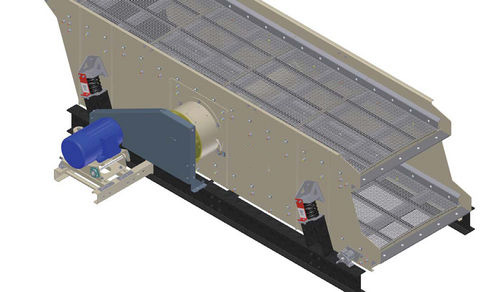
Currently, to serve the needs of large-scale production, people use sieve machines to classify coffee bean size. The vibration speed and amplitude are large, and can process 12-14 tons of raw material per hour.
However, it is difficult to classify coffee bean size with 100% accuracy. For example, due to the high density, some beans, although small, do not fall through. Therefore, in its classification standard system, SCA allows a 5% difference with sieve measurements (that is, in 100 coffee beans on sieve 18, there are allowed to be 5 beans smaller or larger).
Just like cooking potatoes, the larger the batch, the longer it takes to cook. Or when potatoes are of different sizes, they will cook unevenly. The same goes for coffee beans, the larger the bean, the longer it takes to roast, so before roasting we must ensure that each batch of coffee beans has a uniform bean size to help the roasting process be consistent and therefore the quality of the finished product is better.
