When international buyers look for Vietnamese coffee suppliers, one question keeps coming up: “Do you have HACCP certification?” It’s a simple question, but the answer reveals a lot about a supplier’s quality standards and professionalism.
Here’s something surprising: Vietnam is the world’s second-largest coffee exporter, producing over 1.5 million tons annually. But when it comes to roasted coffee suppliers with proper international food safety certifications, the options become very limited. Less than 15% of Vietnamese roasted coffee exporters actually maintain active HACCP certification.
This creates both a challenge and an opportunity for international buyers seeking quality Vietnamese coffee partners.
What Is HACCP?
HACCP stands for Hazard Analysis and Critical Control Points. It’s an internationally recognized food safety management system that was originally developed by NASA in the 1960s to ensure astronaut food was completely safe.
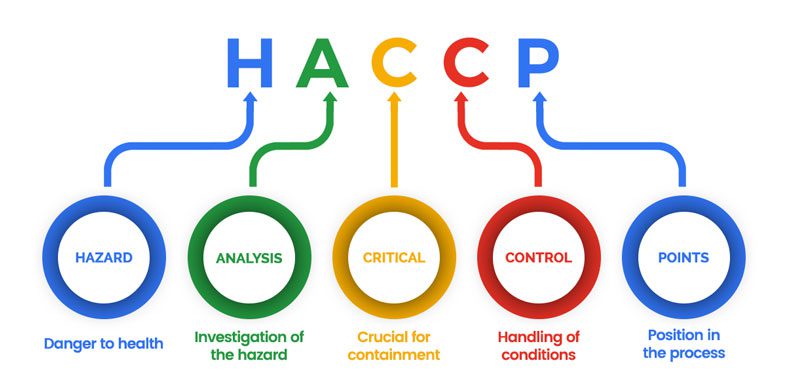
For coffee production, HACCP means having a systematic approach to identify and control potential hazards at every stage:
- Receiving raw beans: Checking for contamination, proper moisture levels, and quality
- Storage: Controlling temperature, humidity, and preventing mold growth
- Roasting: Monitoring temperatures and preventing cross-contamination
- Grinding and packaging: Ensuring cleanliness and preventing foreign objects
- Final storage and shipping: Maintaining product quality until delivery
The key difference between HACCP-certified facilities and regular ones is simple: everything is documented, measured, and controlled according to strict international standards. If something goes wrong, there are written procedures to fix it immediately.
Why Is HACCP Important for Coffee?
Coffee might seem like a low-risk product, but several food safety issues can occur during processing:
- Mycotoxins: These are toxic compounds produced by mold that can develop on coffee beans during drying and storage. Common ones include ochratoxin A and aflatoxin. While roasting reduces these toxins, it doesn’t eliminate them completely. The best approach is preventing contamination in the first place.
- Physical contamination: Stones, metal fragments, or other foreign objects can mix with coffee beans during processing if proper controls aren’t in place.
- Chemical contamination: Cleaning agents, equipment lubricants, or pesticide residues can contaminate coffee if handling procedures aren’t strict.
- Cross-contamination: In facilities that process multiple products, allergens or other contaminants can transfer between batches without proper separation.
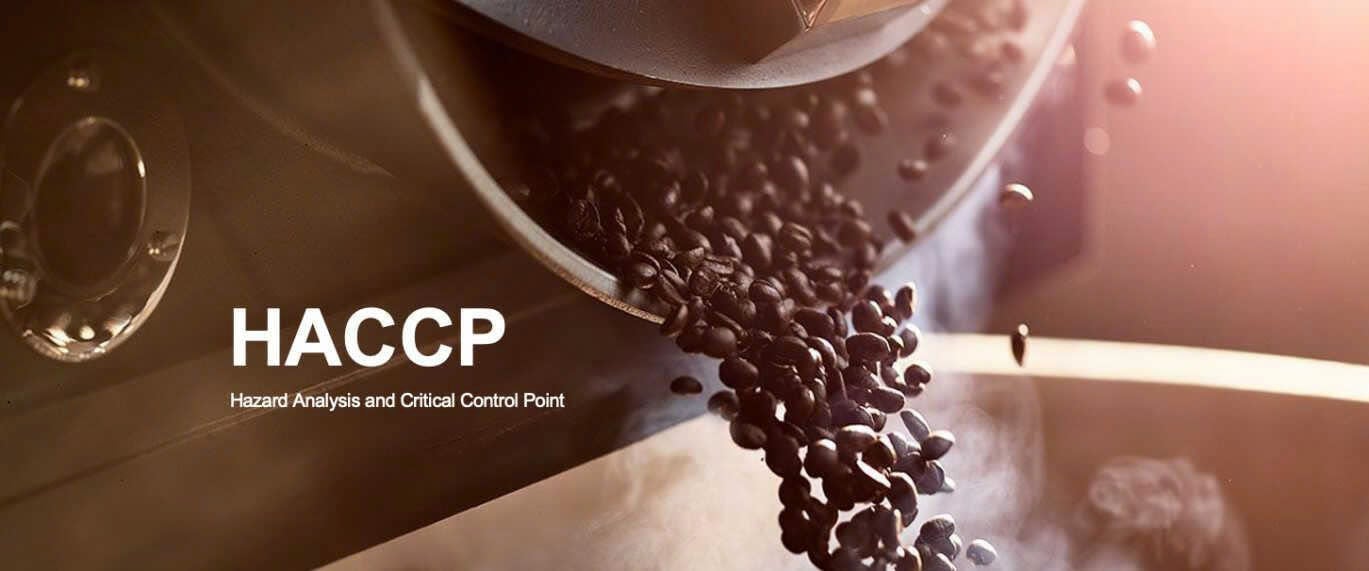
HACCP certification means a supplier has systems in place to prevent all these issues before they happen, not just react after problems occur.
Why So Few Vietnamese Coffee Suppliers Have HACCP
If HACCP is so important, why don’t more Vietnamese coffee companies have it? The answer comes down to several practical challenges:
- High upfront costs: Retrofitting a facility to meet HACCP standards typically costs tens of thousands of dollars. This includes new equipment, facility modifications, testing systems, and documentation software.
- Ongoing expenses: Maintaining certification isn’t cheap. Companies need dedicated food safety staff, regular third-party audits (usually twice a year), continuous employee training, and routine product testing. For smaller businesses operating on thin profit margins, these recurring costs are difficult to justify.
- Knowledge gaps: Many Vietnamese coffee processors are experts at growing and processing coffee, but they have limited experience with international food safety management systems. Understanding HACCP principles, implementing them correctly, and maintaining English documentation for international auditors requires specialized expertise.
- Traditional business model: For decades, most Vietnamese coffee exporters focused on selling green beans in bulk. Their international customers—the roasters in consuming countries—handled all the food safety certification for finished products. This division of labor worked well, so many Vietnamese businesses never saw the need to invest in certifications like HACCP.
- Limited market pressure: Until recently, most buyers of Vietnamese coffee were looking for commodity-grade green beans, where HACCP wasn’t required. Only now, as more buyers seek roasted, packaged coffee directly from Vietnam, has the certification gap become a real business issue.

The result is a Vietnamese coffee industry with enormous production capacity but limited certified infrastructure for value-added products.
The Real Benefits of HACCP for International Buyers
For international buyers, working with a HACCP-certified Vietnamese supplier offers several concrete advantages:
- Reduced risk: You don’t have to worry about contamination issues that could lead to rejected shipments, expensive recalls, or damage to your brand reputation.
- Regulatory compliance: Many importing countries require or strongly prefer HACCP certification for food products. The European Union, for example, expects coffee processors to follow HACCP principles. With a certified supplier, import clearance is straightforward.
- Consistent quality: HACCP certification requires systematic quality control throughout production. This means more consistent coffee from batch to batch.
- Full traceability: HACCP-certified suppliers maintain detailed records of every step in production. If you need to trace a specific batch or answer customer questions, the documentation is readily available.
- Easier retail partnerships: Major supermarket chains and food retailers increasingly require HACCP certification from their suppliers. Having a certified source makes it easier to meet these requirements.
- Peace of mind: You can trust that your supplier has invested in proper food safety systems, not just made verbal promises about quality.
Hello 5 Coffee’s HACCP Journey
Hello 5 Coffee obtained HACCP certification in 2020 after an 18-month implementation process. The decision to pursue certification wasn’t driven by regulatory requirements—at the time, it wasn’t mandatory for the Vietnamese market. Instead, it came from the company’s founding principle of “compliance” and a commitment to serving international markets properly.
The certification process required significant changes:
- Upgrading the production facility in Ho Chi Minh City with new monitoring equipment
- Installing temperature and humidity sensors throughout the facility
- Redesigning workflow patterns to prevent cross-contamination
- Implementing comprehensive digital documentation systems
- Training all employees on food safety principles and HACCP procedures
- Establishing regular testing protocols for raw materials and finished products
Today, the facility operates with clear food safety protocols visible at every stage. Green beans are tested upon arrival. Storage areas maintain controlled conditions with continuous monitoring. The roasting area uses dedicated equipment and strict cleaning schedules. Packaging happens in controlled environments to prevent contamination.
Beyond HACCP, Hello 5 Coffee also holds HALAL certification (for Muslim-majority markets) and Kosher (COR) certification (for Jewish dietary requirements). The facility is also registered with the U.S. FDA for export to American markets.
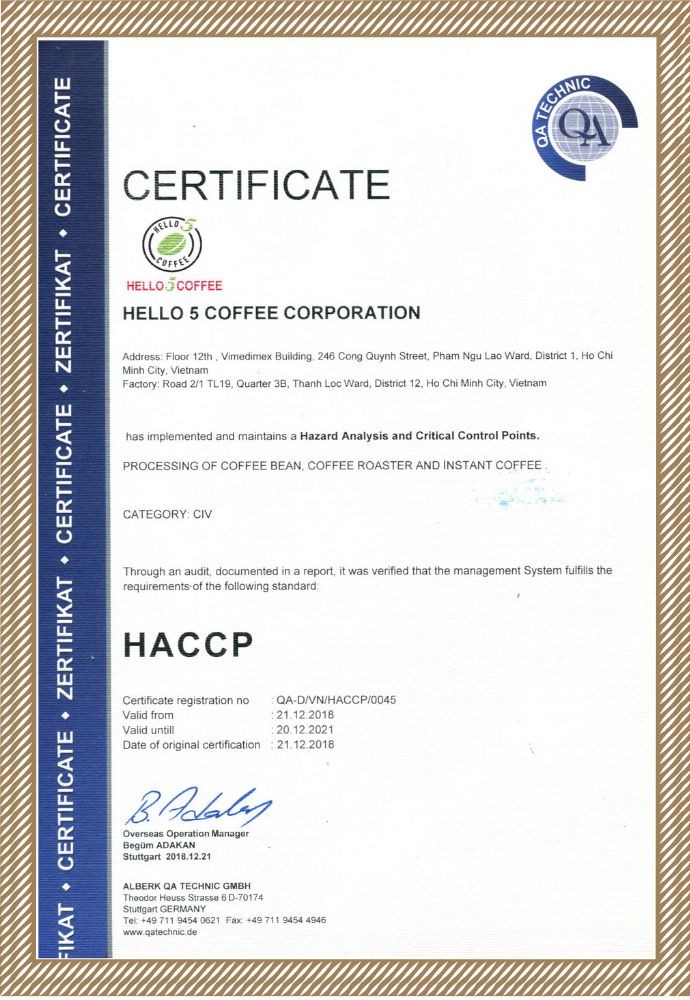
This comprehensive certification portfolio places Hello 5 Coffee among the top tier of Vietnamese coffee processors in terms of international credibility—a small group when you consider Vietnam’s thousands of coffee businesses.
What to Look for in a HACCP-Certified Supplier
Not all HACCP certifications are the same quality. Here’s what to verify when evaluating suppliers:
- Check certification authenticity: Ask for a copy of the current certificate and verify it’s from a recognized, accredited certification body. Check the expiration date—certificates need regular renewal.
- Verify the scope: Make sure the certification covers the specific products and processes you need. Some certifications only cover certain product types or facility areas.
- Request supporting documentation: Legitimate HACCP-certified facilities should easily provide facility diagrams, critical control point specifications, and sample monitoring records.
- Visit if possible: The best way to verify HACCP compliance is seeing it in action. Clean facilities, organized workflows, posted procedures, and trained employees who understand food safety all indicate genuine implementation, not just paperwork.
- Ask about continuous improvement: How often is the HACCP plan reviewed? What changes have been made based on recent audits? Suppliers who treat HACCP as a living system rather than a static document demonstrate real commitment.
The Competitive Advantage of HACCP Certification
The scarcity of HACCP certification among Vietnamese coffee suppliers creates a unique market dynamic. For the certified suppliers, it provides a significant competitive advantage:
- Market access: Many international markets and retail chains simply won’t work with non-certified suppliers. HACCP certification opens doors that remain closed to competitors.
- Premium positioning: Buyers seeking quality suppliers naturally filter for certifications. This allows certified suppliers to position themselves in premium market segments rather than competing primarily on price.
- Stronger partnerships: International buyers who find certified suppliers tend to build long-term relationships rather than constantly switching between vendors. The investment in certification signals reliability and professionalism that buyers value.
- Operational efficiency: The systematic approach required by HACCP often improves overall operations beyond just food safety. Better inventory management, reduced waste, improved quality consistency, and clearer procedures all typically follow HACCP implementation.
For Hello 5 Coffee, HACCP certification has directly led to partnerships with specialty coffee retailers, food service distributors, and private label clients who require certified co-manufacturers. These opportunities simply wouldn’t exist without the certification.
Making the Right Choice
When sourcing Vietnamese coffee, the choice often comes down to priorities:
If you’re looking for the absolute lowest price and your market doesn’t require food safety certifications, working with non-certified suppliers might be fine. You’ll have more options and potentially lower costs.
But if you’re serving regulated markets, supplying major retailers, building a quality brand reputation, or seeking reliable long-term partnerships, HACCP certification isn’t optional—it’s essential.
The question isn’t whether HACCP certification matters. The question is whether you’re willing to accept the risks and limitations of working with suppliers who don’t have it.
Why Choose Hello 5 Coffee
Hello 5 Coffee’s certifications—HACCP, HALAL, and Kosher—represent years of investment in infrastructure, training, and operational discipline. But the real value isn’t the certificates on the wall. It’s what they represent:
- Systematic quality control at every production stage
- Complete traceability from green bean to finished product
- Compliance with international food safety standards
- Professional operations that meet global market requirements
- Reliable partnership with documented quality assurance
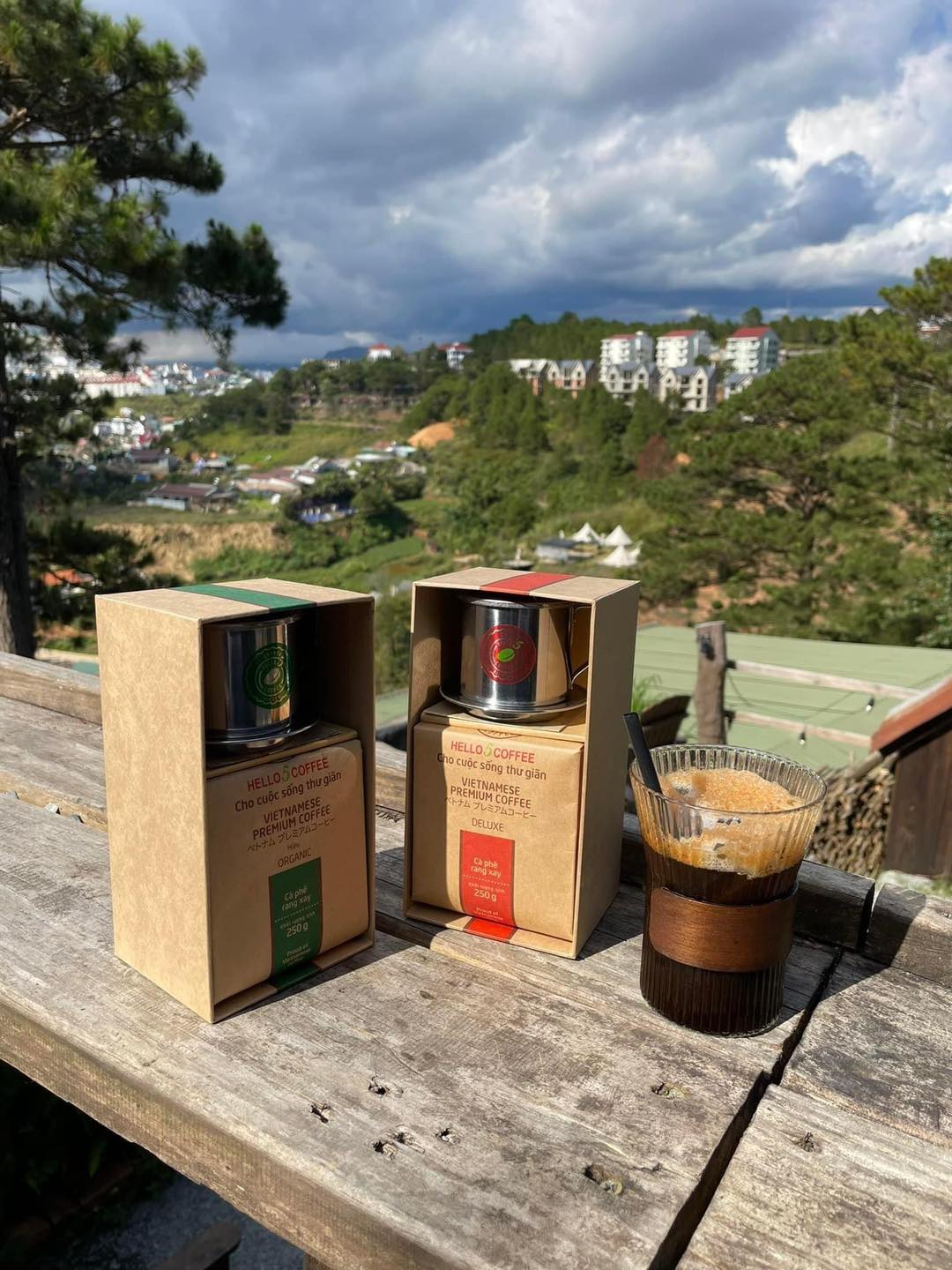
The facility can produce up to 150 tons of roasted coffee monthly, serving international partners across Europe, North America, and Asia. Whether you need bulk roasted beans, ground coffee, instant coffee, or private label solutions, the HACCP-certified operations ensure consistency and safety from facility to customer.
In a Vietnamese coffee industry where HACCP certification remains rare, working with Hello 5 Coffee means partnering with a supplier who’s made the investment to serve international markets properly. It’s the difference between hoping quality standards are met and knowing they can be proven.
Contact Hello 5 Coffee:
- Email: info@hello5coffee.com
- Phone: (+84) 81 535 5505
- Website: hello5coffee.com
Let’s discuss how our HACCP-certified Vietnamese coffee can meet your specific market requirements.
